
What We Talk About When We Talk About Baseball
So why do grown men read books about the baseball games of their youth?

Discussed: Pitch by Pitch: My View of One Unforgettable Game by Bob Gibson and Lonnie Wheeler
Cited: Wilfrid Sheed’s essay “Confessions of a Sports Nut”
A book about pitch selection in a baseball game played 57 years ago is not for everyone. But I wouldn’t have bothered with Pitch by Pitch if that is all that I was looking for.
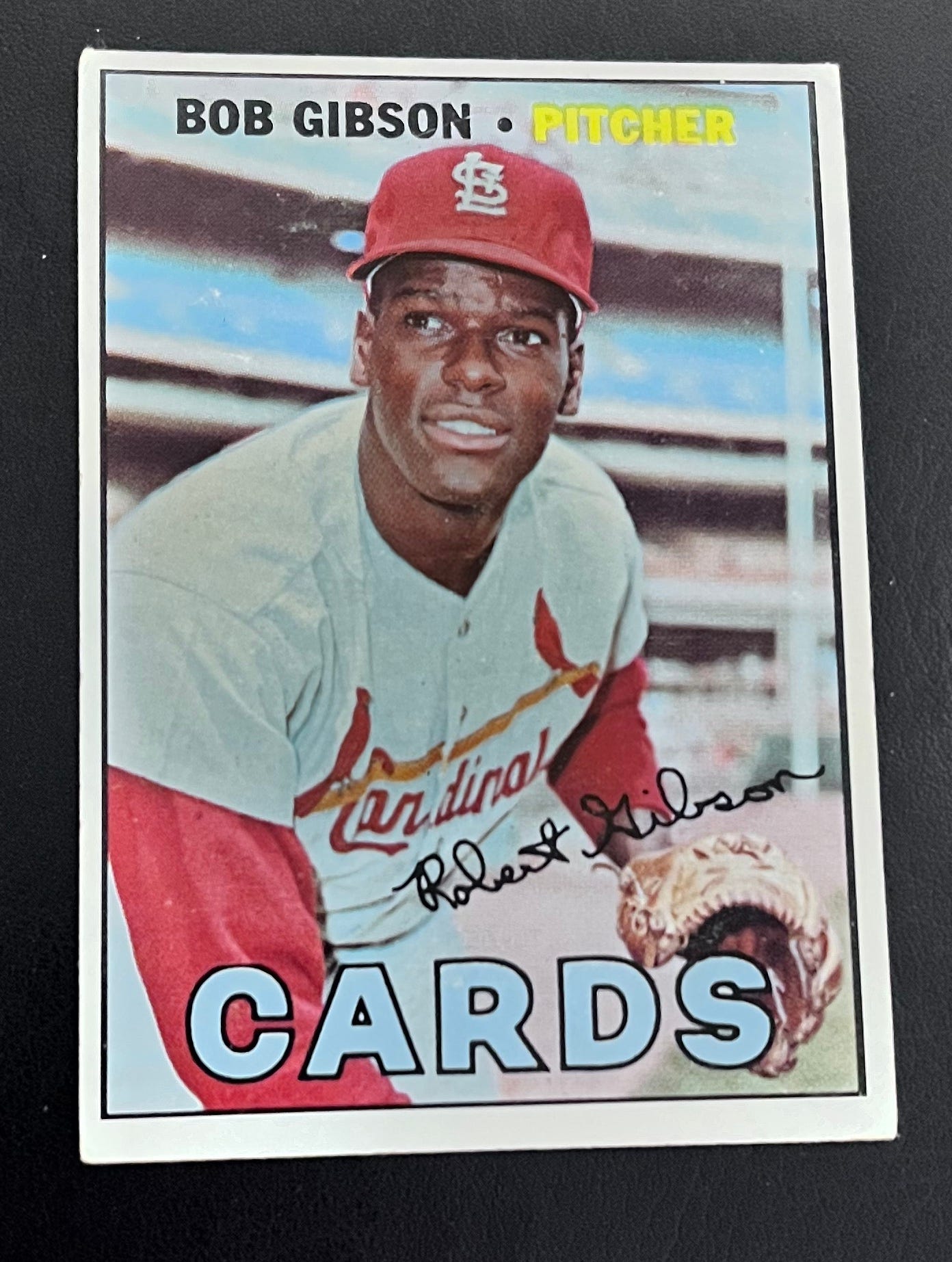
We talk about the joys of being a boy in the 60s
But Bob Gibson’s account of the 1968 World Series game in which he struck out 17 Detroit Tigers brought back the version of baseball I fell in love with.
Following baseball in those years was an experience closer to reading than to watching—you participated, you reconstituted an experience. Yes, I tuned-in games on a weather-sensitive, black-and-white TV. But I also listened to games on scratchy transistor radios, reconstructed them from newspaper accounts and box scores, simulated them on Stratomatic board games, and role-played them in our yard with my friends
We talk about the complexities of being a man, especially if you’re Black and it’s 1968
And the book is about much more than pitch selection, as Gibson (aided by Lonnie Wheeler) shares his past and present and profiles each player.
The most interesting of those profiles is his catcher, Tim McCarver. When they first met, McCarver said he could understand the racism Gibson felt because McCarver, a Catholic, was from Memphis, a city which was over 90% Protestant.
The relationship improved, and by the end of the book, the depth of Gibson’s respect for McCarver, and the extent of McCarver’s growth, become an optimistic subtext.
The darkest of the profiles is the story of Curt Flood, the talented center fielder who, by refusing to be treated as well-compensated chattel, set off a chain of events that eventually led to baseball players owning their own labor. The key word is “eventually.” Gibson details the toll that fight took on his friend.
If you’ve ever spent a night with a friend whose drinking has crossed the line into alcoholism, you’ll despair with Gibson. An enthusiasm has become an engine, and it’s destroying a man who created opportunities for thousands of men.
And that reminded me of a quote. After admitting that he had, in fact, immersed himself too deeply in sports when he arrived in America from England as a boy, Wilfrid Sheed writes:
Having said that, let me double back on it: if you had to limit yourself to one aspect of American life, the showdowns between pitcher and hitter, quarterback and defense, hustler and fish would tell you more about politics, manners, style in this country than any one other thing. Sports constitute a code, a language of the emotions, and a tourist who skips the stadiums will not recoup his losses at Lincoln Center and Grant’s Tomb.
—Wilfrid Sheed, “Confessions of a Sports Nut”